Multiple sclerosis rehabilitation: fatigue, spasticity and movement
Multiple sclerosis behaves differently in every person, and changes in the same person
from one period to the next. On this page we have put together a straightforward
explanation of what happens in the body, why the old advice to avoid exertion has been
reversed, and how to work around fatigue and heat sensitivity without
overloading.
30+ years of research
Made in Germany
Petah Tikva
Galileo® MedRehabilitation and motor function
What happens in the body in multiple sclerosis
Multiple sclerosis is an autoimmune disease of the central nervous system. The immune
system mistakenly attacks the myelin, the insulating layer that wraps
the nerve fibers. Myelin is what allows the electrical signal to travel quickly and
precisely along the nerve.
When that insulation is damaged, the signal arrives more slowly, distorted, and sometimes
not at all. Think of it like an electrical cable whose coating has cracked. The cable is
still there, but the conduction is no longer reliable.
Two points follow from this that are important to understand. First:
the muscles themselves are healthy. What is damaged is the transmission
of the command to them. Second: the location of the lesions in the nervous system varies
from person to person, which is why multiple sclerosis presents so differently. For one
person it is mainly a walking problem, for another sensation or vision, and for a third,
fatigue is the dominant symptom.
Here too, a secondary cycle develops that worsens over time and does not stem directly
from the disease: movement decreases because of fatigue or apprehension, so the muscles
weaken and lose mass, ranges of motion shrink and balance suffers. These make movement
even harder. This cycle can genuinely be influenced, and that is exactly
what rehabilitation targets.
Why the advice to rest has been reversed
If you were diagnosed years ago, you may have been told to avoid exertion. That advice
was common, and it came from a concern that physical effort would worsen the disease or
trigger relapses.
That thinking has changed. What became clear is that the worsening of symptoms during
exertion is linked mainly to a rise in body temperature, not to
neurological damage, and it passes as the temperature comes back down. Today, structured,
properly adapted physical activity is considered a recommended component of managing the
disease, and studies show support for improvements in muscle strength, balance and
walking endurance.
The practical takeaway is not that you can train without limits. The key is
adaptation: the right intensity, short sets instead of prolonged effort,
and control of heat and time. More on that below.
The common motor challenges
Spasticity
An increase in muscle tone that shows up as stiffness, resistance to movement and
sometimes spasms. It is one of the most common symptoms in multiple sclerosis, and it
directly affects walking, dressing and sleep. Spasticity is not weakness, so it calls
for a different approach: not just strengthening, but also work on regulating tone and
on range of motion.
Muscle weakness
Usually more pronounced in the legs and pelvis, affecting stair climbing, rising from a
chair and the ability to keep going while walking. Part of the weakness comes from the
disease itself and part from the secondary cycle of reduced movement, and that second
part is precisely the one that can be influenced.
Balance and coordination problems
These stem from damage to the pathways responsible for the sense of position in space
and for coordinating movement. The result is instability, more cautious walking and a
fear of falling, which restricts movement even further.
Reduced walking endurance
Not necessarily difficulty walking, but difficulty keeping it up over distance. That is
why an accepted measure in assessing multiple sclerosis is the
six-minute walk test, which checks how much distance is covered in
continuous walking, not just whether walking is possible.
Fatigue and heat sensitivity, and how to work around them
These are the two issues that dictate, more than anything else, what treatment in
multiple sclerosis needs to look like, which is why they get their own section here.
Fatigue
Fatigue in multiple sclerosis is the most common complaint, and it is different from
ordinary tiredness. It is not proportional to effort, does not always pass after rest,
and can appear without warning. It is also the main reason training programs fail: they
simply demand more than there is.
The practical principle is short sets with breaks, instead of one
prolonged effort. The goal is quality of activation, not length of time.
Heat sensitivity, Uhthoff's phenomenon
For many people, a rise in body temperature causes a temporary worsening of symptoms,
from blurred vision to increased weakness. It sounds frightening, but it is important
to understand: this is a temporary worsening, not damage, and it passes
once your temperature returns to normal.
In practice, this means treatment needs to be planned with air conditioning, hydration,
breaks and short sets. If you have this kind of sensitivity, it is one of the most
important things to tell us at your first appointment.
Where Galileo comes in
Active. Not passive.
The previous section leads to a demanding requirement: you need meaningful muscle
activation, but in a short time and without raising body temperature. That is exactly
where this method becomes relevant.
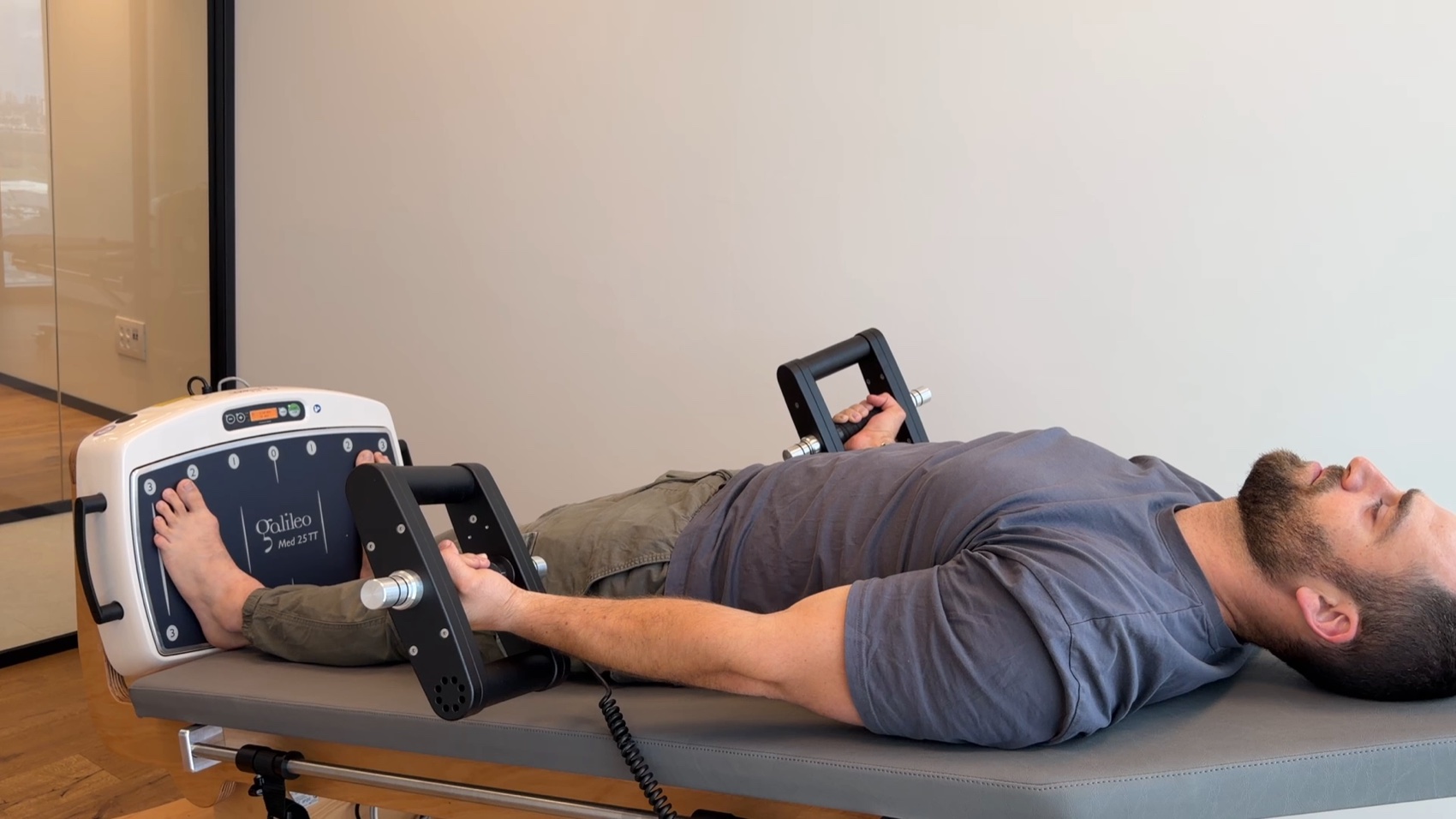
This is not a treatment performed on you while you lie passively. The method is
based on a gentle, controlled movement that mimics the natural walking pattern. The
nervous system recognizes it and responds with reflexive muscle
contractions, dozens of times per second. The practical meaning: a large number of muscle
activations within just a few minutes, without prolonged aerobic effort and without
loading the joints.
Active muscle engagement, not passive stimulation
Up to 40 muscle contractions per second in each leg
Short sets, well suited to working around fatigue
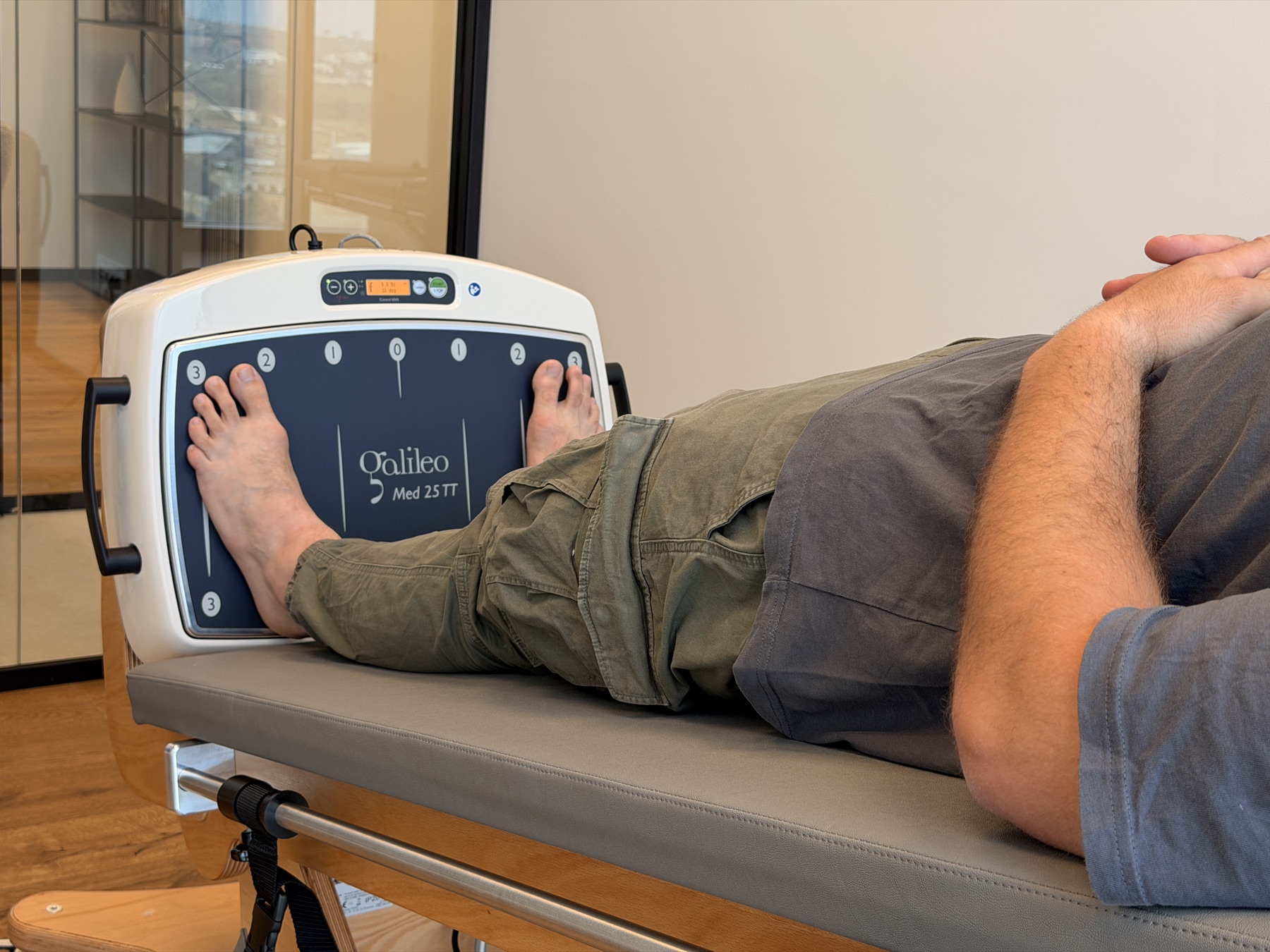
Can be done seated, lying down or in supported standing
Three stages, paced by your functional ability, not by a one-size-fits-all protocol.
01
Assessment and tailoring
A first appointment in which we assess functional status, spasticity, balance and
medical limitations. In multiple sclerosis we look especially at fatigue levels and
heat sensitivity, and the structure of the sets is built from these.
02
Controlled activation
The treatment is short and divided into sets with breaks, so as not to overload and
not to raise body temperature. A physiotherapist accompanies you throughout,
correcting position and adjusting the intensity in real time.
03
Tracking and progression
The load increases gradually according to your actual response, including how your
fatigue responds the next day. We measure and document so improvement can actually be
seen, rather than relying on feel alone.
Research-based
What does the research say about vibration therapy in multiple sclerosis?
Galileo (made by Novotec Medical, Germany) is the device that invented side-alternating
vibration and the most researched of its kind in the world. Below are findings from
studies published in scientific journals on whole-body vibration training in multiple
sclerosis.
Randomized pilot study · Galileo Med 25 TT
An increase in walking distance was observed, along with a trend toward relief in perceived spasticity.
A randomized controlled pilot study of 30 people with progressive multiple sclerosis,
using the very same Galileo Med 25 TT platform, found an increase in walking distance
on the six-minute walk test (about 38 m), alongside patient reports of a positive
effect related to spasticity.
Significant improvement in balance and walking endurance.
A systematic review and meta-analysis of 14 randomized studies (393 participants with
multiple sclerosis) found a significant advantage for vibration training in improving
balance (P=0.03) and walking endurance (P=0.01).
Frontiers in Aging Neuroscience, 2022 · systematic review and meta-analysisRandomized clinical trial
Significant improvement in physical quality of life.
A randomized clinical trial in people with multiple sclerosis, using the Galileo
platform, found a significant improvement in the physical component of quality of
life (SF-36 questionnaire, P=0.013), alongside improvements in additional functions.
International Journal of MS Care, 2022 · randomized clinical trialMeta-analysis · 201 participants
Significant improvement in knee-extensor muscle strength.
A systematic review and meta-analysis of 7 controlled studies (201 participants with
multiple sclerosis) found a statistically significant improvement in quadriceps
muscle strength (P=0.003).
Multiple Sclerosis and Related Disorders, 2016 · systematic review and meta-analysis
The findings refer to study groups and are not a guarantee of individual results. Nothing
here is a substitute for medical advice or for your medication.
Transparency
Who it suits, and what to check first.
It is not right for everyone, and that is fine. Here is the picture as it is, so you can
come to the appointment with the right expectations.
Usually suitable for those who...
Are diagnosed with multiple sclerosis and stable, between relapses
Are dealing with spasticity, weakness or balance difficulties
Struggle to keep up a training program because of fatigue
Want to preserve function and prevent the secondary cycle of reduced movement
Feel their progress in physiotherapy has stalled and want to add another layer
Carefully screened before starting
An active relapse or a recent worsening of symptoms
A recent change in medication
Active blood clots or a history of thrombosis
Recent fractures, advanced osteoporosis or recent surgery
Epilepsy, a pacemaker, medical implants or pregnancy
The screening list is not an automatic list of exclusions, but a set of issues clarified
at the assessment appointment, and sometimes with your treating physician. The decision
whether to start, and at what intensity, is made individually. In any case, we recommend
informing your treating neurologist before starting any new treatment.
I was once told not to exert myself. What changed?
For years, the standard advice was to avoid exertion for fear of worsening the disease. That thinking has changed. What became clear is that the worsening of symptoms during exertion is linked mainly to a rise in body temperature and passes as the temperature comes down. Today, structured, properly adapted physical activity is considered a recommended component of managing the disease. The key is getting the intensity and duration right, not avoidance.
I have severe fatigue. How can I possibly train?
Fatigue is the most common complaint in multiple sclerosis, and it is factored into how the treatment is planned. The principle is short sets with breaks, rather than one prolonged effort. The method delivers a large number of muscle activations within just a few minutes, which makes meaningful work possible even in a short session.
I am sensitive to heat and feel worse when I get hot. Is that a problem?
Heat sensitivity, known as Uhthoff's phenomenon, is common in multiple sclerosis. A rise in body temperature can temporarily worsen symptoms, and the effect passes once your temperature returns to normal. It is a temporary worsening, not damage. We account for this in the plan: short sets, breaks, air conditioning and hydration. It is important to tell us about this kind of sensitivity at your first appointment.
Is the treatment suitable during a relapse?
During an active relapse, this type of treatment is not started or continued. You should wait until your condition stabilizes and coordinate with your treating neurologist. The rehabilitation is suited to the periods between relapses and to a stable condition.
Does the treatment help with spasticity?
Spasticity is one of the central targets in multiple sclerosis rehabilitation. A randomized controlled pilot study using the Galileo Med 25 TT platform in people with progressive multiple sclerosis reported a positive effect related to spasticity, alongside an increase in walking distance. The findings refer to study groups and are not a guarantee of individual results.
Is the treatment also suitable for wheelchair users?
In many cases, yes. The treatment can be given seated, lying down or in supported standing, and the upper body can also be worked using therapy handles. Position and intensity are set according to your actual functional ability, in an individual assessment.
Does the treatment replace physiotherapy or my medication?
No. It is a tool within a rehabilitation process, not a substitute for medication or neurological follow-up. It works alongside physiotherapy and the other treatments prescribed for you.
Am I entitled to reimbursement from my health fund or insurance?
In many cases, partial reimbursement is available through supplementary health plans or private insurance, depending on the terms of your policy. We issue a treatment confirmation and receipt so you can submit your claim. More about reimbursement
Let's talk
Not sure whether it fits your situation?
That is exactly what the assessment appointment is for. We will go over your functional
status, tell you honestly whether we think there is value here for you, and if not, we
will say so. You can also simply call and ask.