Parkinson's rehabilitation: what really helps movement
Parkinson's shows itself first in the small things, a button that is hard to fasten, a
first step that won't come, handwriting that shrinks. On this page we have put together a
straightforward explanation of what happens in the body, why
exercise has become one of the most researched tools in the disease, and
where Galileo therapy fits into the process.
30+ years of research
Made in Germany
Petah Tikva
Galileo® MedRehabilitation and motor function
What happens in the body in Parkinson's
Parkinson's is a progressive neurological disease in which nerve cells in a brain region
called the substantia nigra gradually stop functioning. These cells
produce dopamine, a neurotransmitter that plays a central role in regulating movement.
There is a point here that confuses many families: the problem is not in the muscles and
not in strength. A person with Parkinson's can be perfectly strong. What is affected is
the control system for movement, and above all the ability to perform
automatic movements, the ones we make without thinking about them.
This explains a phenomenon that looks contradictory: the same person who struggles to
start walking down a corridor can suddenly climb stairs with relative ease, or walk at a
good pace when someone provides an external rhythm. The stair and the rhythm supply an
external cue that bypasses the damaged automatic mechanism. This
principle underlies a large part of Parkinson's rehabilitation.
Alongside this, a secondary cycle develops that worsens the situation over time, and it
does not come from the disease itself: movement decreases, so strength declines, range of
motion narrows and posture changes. Less movement leads to less confidence, less
confidence leads to even less movement. The important part is that this secondary cycle
can genuinely be influenced, and that is exactly what rehabilitation
targets.
Why exercise became a central tool
For years, exercise in Parkinson's was treated as a general health recommendation. That
picture has changed. Today, structured exercise is considered one of the most researched
subjects in the field, and it appears in treatment guidelines as a core component
alongside medication, not as a nice-to-have.
The rationale rests on neuroplasticity, the nervous system's ability to
adapt and change its patterns in response to repeated practice. Training at sufficient
intensity and with high repetition gives the system exactly the stimulus it needs to
preserve and strengthen movement pathways.
From these follow two practical conclusions that recur throughout the literature:
It is better to start early, even while function is still good. The
goal is to build a reserve and preserve healthy movement patterns before the body
develops compensation patterns that are hard to undo later.
Intensity and repetition matter. Practice that is too little or too
light does not provide the necessary stimulus. This is a hard point to put into
practice when movement itself is the challenge, and we will come back to it below.
To be explicit: exercise does not cure the disease and does not replace medication or
neurological follow-up. It works alongside them.
The common motor challenges
Parkinson's presents differently in every person, but several challenges keep recurring,
and each carries a different meaning for rehabilitation.
Bradykinesia, slowness of movement
This is the central sign of the disease. Movements become slower and smaller, sometimes
without the person being aware of it. It is what shrinks handwriting, shortens stride
length and weakens the voice.
Muscle rigidity
A feeling of stiffness and resistance to movement, sometimes accompanied by pain,
especially in the shoulders and neck. Rigidity narrows range of motion and makes trunk
rotation harder, a movement needed in every walk, every rise from a chair and every turn
in bed.
Balance and postural problems
The tendency to stoop forward shifts the center of gravity, and the automatic postural
reactions that are supposed to steady us when we lose balance grow weaker. Together, these
raise the risk of falling, which is why this is one of the central goals of
rehabilitation.
Freezing of gait
A feeling that the feet are glued to the floor, usually at the start of walking, when
turning, or when passing through a doorway. It is especially unsettling because it is
unpredictable. Here too, external cues, a rhythm or a marking on the floor, help some
people.
Resting tremor
The sign most identified with the disease, yet often the one that affects daily function
less than the slowness and the rigidity. It appears mainly at rest and lessens during
intentional movement.
Where Galileo comes in
Active. Not passive.
The previous section raised a practical problem: rehabilitation demands high repetition,
but when movement itself is slow and difficult, it is very hard to accumulate enough
repetitions. This is exactly where this method becomes relevant.
This is not a treatment performed on you while you lie there passively. The
method is based on a gentle, controlled movement that mimics the body's natural walking
pattern. The nervous system recognizes it and responds with reflexive
muscle contractions, dozens of times per second. In practical terms: a large volume of
muscle activations within just a few minutes, without the conscious effort of initiating
every movement anew, and without loading the joints.
Active muscle engagement, not passive stimulation
Up to 40 muscle contractions per second in each leg
Reaches deep stabilizing muscles that are hard to engage through conventional exercise
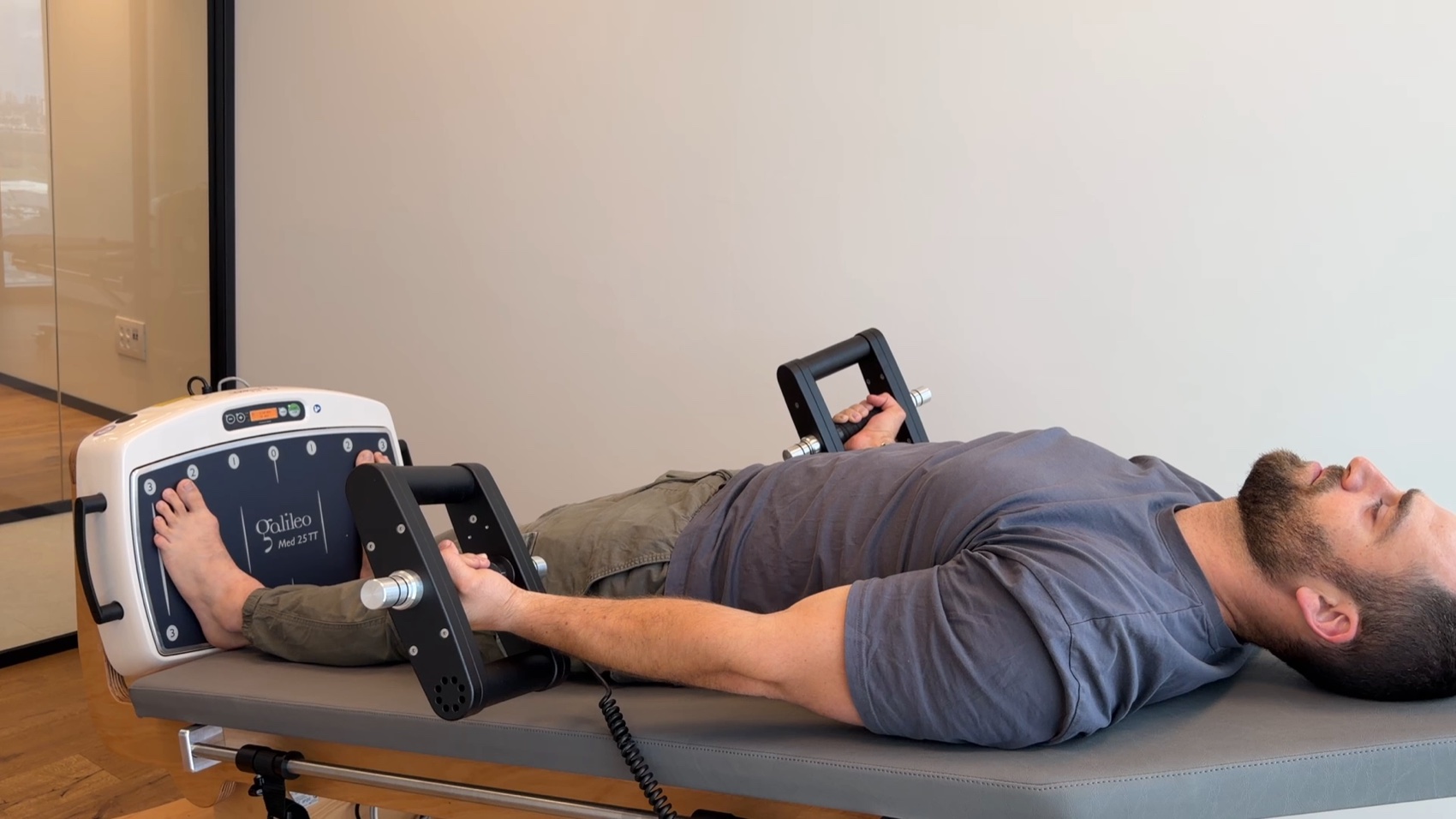
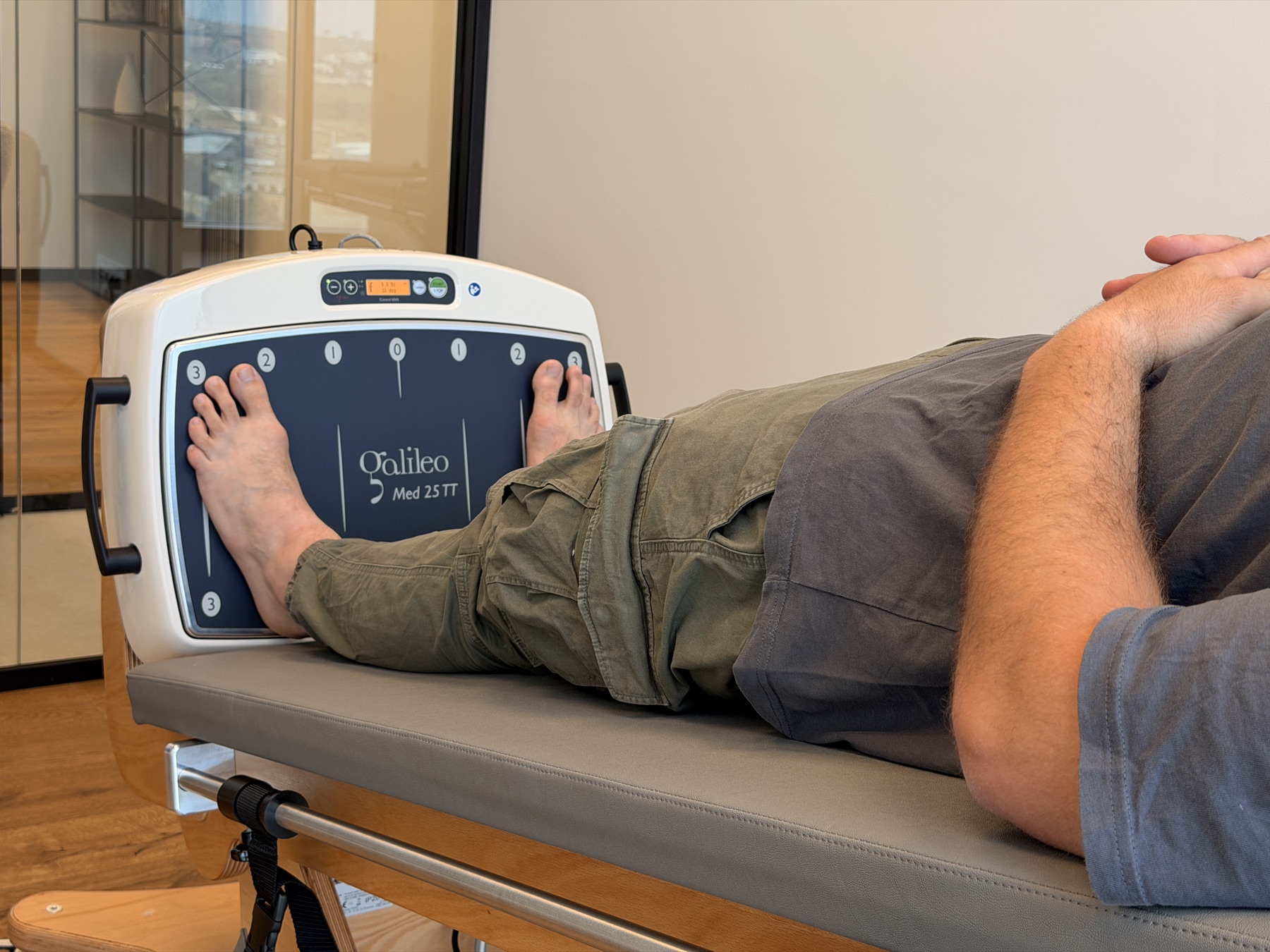
Can be performed sitting, lying down or in supported standing
Three stages, at a pace set by your functional ability, not by a one-size-fits-all protocol.
01
Assessment and fit
A first appointment reviewing your functional condition, range of motion, balance and
medical limitations. In Parkinson's we also review timing relative to your medication,
so sessions can be scheduled for the hours when function is best.
02
Controlled activation
The session itself is relatively short and divided into rounds with breaks. Throughout,
a physiotherapist stays with you, correcting position and adjusting the intensity in
real time.
03
Tracking and progression
The load increases gradually according to your actual response. We measure and document
so it is possible to see whether there is improvement, rather than relying on feeling
alone.
Research-based
What does the research say about whole-body vibration in Parkinson's?
Galileo (made by Novotec Medical, Germany) is the device that invented side-alternating
vibration, and the most researched of its kind in the world. Below are findings from
studies published in scientific journals on whole-body vibration training in Parkinson's.
Randomized controlled trial · 68 participants
An observed improvement in motor score alongside reduced rigidity and tremor.
A randomized controlled cross-over trial in 68 people with Parkinson's, using
whole-body vibration training, found an average improvement of about 17% in motor
score (UPDRS), alongside a reduction in rigidity (about 25%) and tremor (about 24%).
A randomized clinical trial in people with Parkinson's found significant improvement in
the Timed Up and Go test (TUG, P=0.006) and in the Functional Reach test (P=0.019),
two accepted measures of mobility and balance.
A systematic review and meta-analysis examining whole-body vibration training in people
with Parkinson's found a positive effect on motor function, along with a recommendation
for larger, more controlled follow-up studies.
Brain Impairment (Cambridge) · Systematic review and meta-analysisMeta-analysis
Improvement in static balance.
A meta-analysis of controlled studies found an advantage for whole-body vibration
training in improving static balance compared with active control groups, in people
with Parkinson's.
Meta-analysis, 2025 · Whole-body vibration training in Parkinson's
These findings refer to study groups and are not a promise of individual results. Nothing
here is a substitute for medical advice or for your medication.
Transparency
Who it suits, and what to check first.
It is not right for everyone, and that is fine. Here is the picture as it is, so you can
come to the appointment with the right expectations.
Usually a good fit for someone who...
Has been diagnosed with Parkinson's and is medically stable, at any stage of the disease
Deals with rigidity, slowness of movement or difficulty with balance
Wants to start early and build a functional reserve
Struggles to accumulate a sufficient volume of active exercise on their own
Feels progress in physiotherapy has stalled and wants to add another layer
Carefully reviewed before starting
An unstable medical condition or a significant recent medication change
Active blood clots or a history of thrombosis
Fresh fractures, recent orthopedic surgery or recent back surgery
Deep brain stimulation (DBS), a pacemaker or other medical implants
Epilepsy, pregnancy or active inflammatory processes
The list of items we review is not an automatic disqualification list, but a set of topics
clarified at the assessment appointment, sometimes together with your treating physician.
The decision whether to start, and at what intensity, is made individually. In any case, we
recommend updating your treating neurologist before starting any new treatment.
Does exercise actually help in Parkinson's, or does it only maintain the current state?
Exercise is one of the most researched tools in the disease. Studies show it supports improvement in motor measures such as mobility, balance and muscle strength, not just preservation of the current state. That said, it does not cure the disease and does not replace medication, it works alongside it.
When should rehabilitation start, early on or only once there is difficulty?
The accepted recommendation today is to start as early as possible, even while function is still good. The rationale is to build a functional reserve and preserve healthy movement patterns before the body develops compensation patterns that are hard to undo. It is not too late to start at a more advanced stage, but earlier is better.
Is the treatment suitable for someone with a significant tremor?
Tremor does not rule out treatment. It is assessed at the initial evaluation together with the rest of your functional condition, and the position and intensity are set accordingly. Some of the studies on whole-body vibration training in Parkinson's also examined its effect on tremor and rigidity.
Should I come during my ON state, when the medication is working?
It is usually better to schedule the session for the hours when function is best, that is, when the medication is at peak effect. This allows working in a more stable position and getting more out of the session. Timing is agreed together at the first appointment.
Does the treatment replace physiotherapy or medication?
No. It is one tool within a rehabilitation process and is not a substitute for medication or neurological follow-up. It works alongside physiotherapy and the other treatments prescribed for you, and its purpose is to add a layer of active muscle engagement in a volume that is hard to achieve through conventional exercise.
Is the treatment suitable for someone who finds it hard to stand for long?
Yes, in many cases. The treatment can also be given sitting, lying down or in supported standing, and the upper body can be worked using therapy handles. The position is set according to your actual functional ability.
How many sessions are needed, and when is change visible?
There is no single number, and anyone who quotes one without examining you is simply guessing. Frequency and duration are set according to your functional condition and your actual response. We measure along the way so that the decision whether to continue is based on data rather than feeling alone.
Is reimbursement available from the health fund or insurance?
In many cases partial reimbursement is available through supplementary health plans or private insurance, depending on the terms of your policy. We issue a treatment confirmation and receipt for submitting the claim. More about reimbursement
Let's talk
Not sure whether it fits your situation?
That is exactly why the assessment appointment exists. We will go over your functional
condition, tell you honestly whether we think there is value here for you, and if not, we
will say so. You can also simply call and ask.