01
Assessment and tailoring
A first meeting in which we assess your functional condition, range of motion, balance and medical limitations. From this we set the position, intensity and duration of treatment.
Home› Neurological Rehabilitation› Stroke Rehabilitation
A stroke changes, all at once, things that used to be taken for granted, getting up from a chair, walking around the house, holding a cup. On this page we have put together a straightforward explanation of what happens in the body after a stroke, how long the period of improvement lasts and what is known about it today, and where Galileo® therapy fits into the rehabilitation process.
A stroke (also called a CVA, cerebrovascular accident) occurs when the blood supply to an area of the brain is disrupted, whether by a blocked blood vessel or by bleeding. The affected area stops working normally, and the functional outcome depends on exactly where the damage is and how extensive it is.
When the damage is in areas responsible for movement, the effect is usually felt on one side of the body, the side opposite the injured side of the brain. This is what is called hemiparesis (one-sided weakness) or hemiplegia (one-sided paralysis). There is a point here that families do not always realize: the muscles themselves are usually intact. What is damaged is the command system, that is, the brain's ability to recruit them at the right time and with the right force.
From this follows a cycle that makes things worse over time. The weak side is used less, so it grows weaker still, losing muscle mass and range of motion. The body learns to compensate and shift weight onto the strong side, gait becomes asymmetrical, and confidence in movement drops. The good news is that this cycle also works in the opposite direction, and that is exactly the goal of ongoing motor rehabilitation.
This is probably the question we hear most often, and it frequently comes with a sense of despair. So first of all, the figure itself is partly true: the pace of spontaneous improvement really is fastest in the first weeks and months after the stroke, and it slows down afterwards. That much is well documented in the research.
But "slows down" is not "stops". The idea that after six months nothing changes anymore is not accurate, and it rests on older knowledge. Research on neuroplasticity, the nervous system's ability to change and adapt, shows that the brain keeps forming new connections and reshaping activation patterns for years, provided it receives consistent stimulation and training.
In practice, a considerable share of the studies that examined whole-body vibration training in stroke rehabilitation were conducted specifically with people in the chronic stage, that is, well past that six-month window. Preserving what has been achieved is also a legitimate goal in its own right. In a situation where the weak side tends to keep weakening, training that prevents decline is an achievement, not stagnation.
The picture looks different for every person, but a few challenges come up almost every time and directly affect independence at home:
What they all share is that they improve through activation. The practical question is how to generate a meaningful amount of muscle engagement for someone who finds it hard to activate themselves.
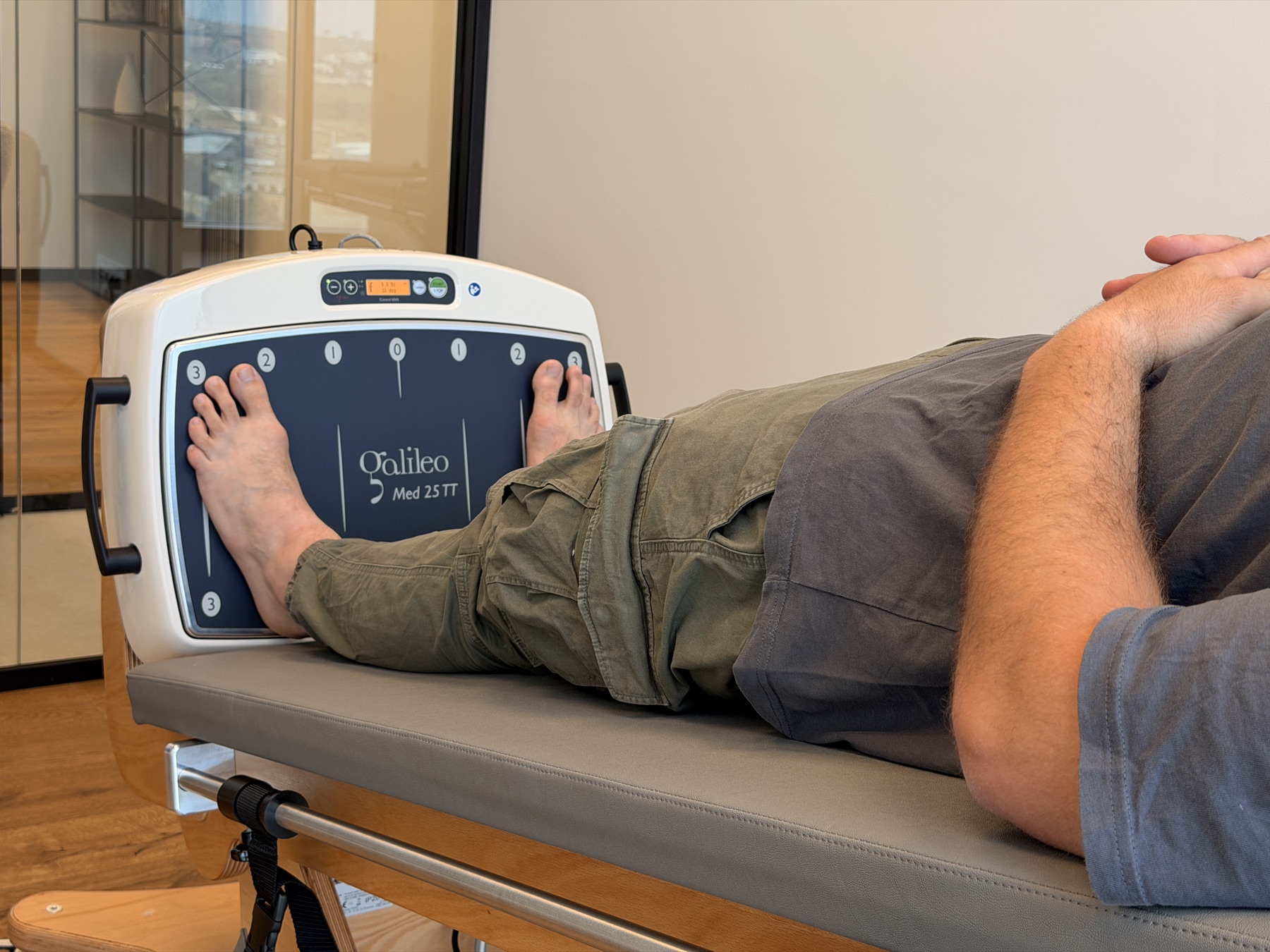
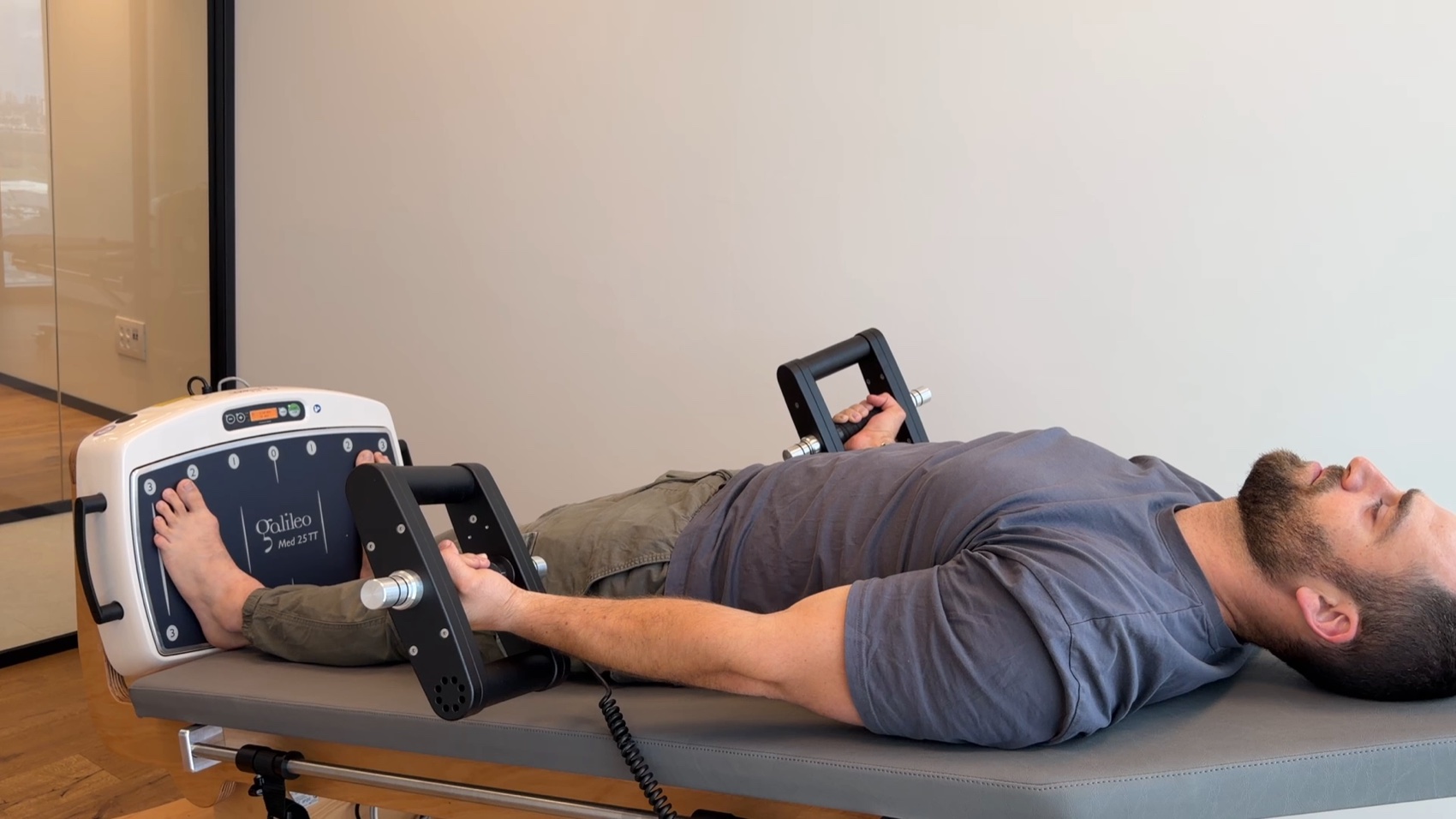
This is the most important point to understand, because it is what sets the method apart from other treatments. It is not a treatment performed on you while you lie there passively. It is training your own body carries out itself.
The therapy is based on a gentle, controlled movement that mimics the body's natural walking pattern. The nervous system detects the movement and responds with reflexive muscle contractions, dozens of times per second. In practical terms: a patient who struggles to complete ten repetitions of a regular exercise receives a large volume of muscle activations within a few minutes, without conscious effort and without loading the joints.
Three stages, at a pace set by your functional ability, not by a fixed protocol.
A first meeting in which we assess your functional condition, range of motion, balance and medical limitations. From this we set the position, intensity and duration of treatment.
The session itself is relatively short and divided into rounds with breaks. Throughout, a physiotherapist stays with you, correcting position and adjusting the intensity in real time.
The load increases gradually according to your actual response. We measure and record so that it is possible to see whether there is improvement, rather than relying on feeling alone.
Galileo (made by Novotec Medical, Germany) is the device that invented side-alternating vibration, and the most researched of its kind in the world. Below are findings from studies published in scientific journals on whole-body vibration training in rehabilitation after a stroke.
A study of people in the chronic stage after a stroke found that intensive whole-body vibration training contributed to improved muscle strength around the knee, alongside improvement in balance measures.
Archives of Physical Medicine and Rehabilitation, 2014 · Tankisheva et al.A study published in the journal Stroke found improved postural control among people after a unilateral stroke, following whole-body vibration training.
Stroke (American Heart Association) · The effect of whole-body vibration on postural controlLiterature reviews in the field note that whole-body vibration training may help reduce muscle tone and the sensation of spasticity, as part of a comprehensive rehabilitation program rather than as a stand-alone treatment.
Literature review · Whole-body vibration, muscle tone and spasticity in stroke rehabilitationSystematic reviews and meta-analyses examining whole-body vibration training in rehabilitation after a stroke reported a positive effect on balance and on functional mobility.
Systematic review and meta-analysis · Whole-body vibration training in neurological rehabilitationNothing here constitutes a promise of results or a substitute for medical advice.
It is not right for everyone, and that is fine. Here is the picture as it is, so you can come to the meeting with the right expectations.
The list of items we review is not an automatic disqualification list, but topics we clarify at the assessment meeting and sometimes with the treating physician. The decision whether to start, and at what intensity, is made individually. In any case, we recommend informing your treating physician before beginning any new treatment.
The timing is decided by the treating medical team and depends on your medical condition and stage of recovery. In the early phase, rehabilitation usually takes place in a hospital or rehabilitation facility. Turning to a complementary treatment like ours is generally appropriate once your medical condition is stable, and always in coordination with your treating physician.
The idea that improvement stops completely after six months is not accurate. The pace of improvement is indeed faster in the first months, but research on neuroplasticity shows that the brain keeps adapting over time, and that ongoing training can help maintain strength, balance and function in the chronic stage as well. Some of the studies on whole-body vibration were conducted specifically with people in the chronic stage.
Yes, in many cases. The treatment can also be given while sitting, lying down or in supported standing, and the upper body can be worked as well using therapy handles. The intensity and position are set according to your actual functional ability, in an individual assessment.
No. It is a tool within a rehabilitation process, not a substitute for it. It works alongside physiotherapy, occupational therapy and the other treatments prescribed for you, and its purpose is to add a layer of active muscle engagement in a volume that is hard to achieve with regular exercise.
The treatment should not be painful. It is a gentle, controlled movement, and the intensity and duration are increased gradually and tailored individually. Mild muscle fatigue after a session is normal, much like after training.
There is no one-size-fits-all number, and anyone who quotes one without assessing you is simply guessing. Frequency and duration are set according to your functional condition and your actual response. We measure along the way so that the decision whether to continue is based on data, not on feeling alone.
In many cases partial reimbursement is available through supplementary health plans or private insurance, depending on the terms of your policy. We issue a treatment confirmation and receipt for submitting your claim. More about reimbursement
That is exactly what the assessment meeting is for. We will go over your functional condition, tell you honestly whether we think there is value here for you, and if not, we will say so. You can also simply call and ask.